
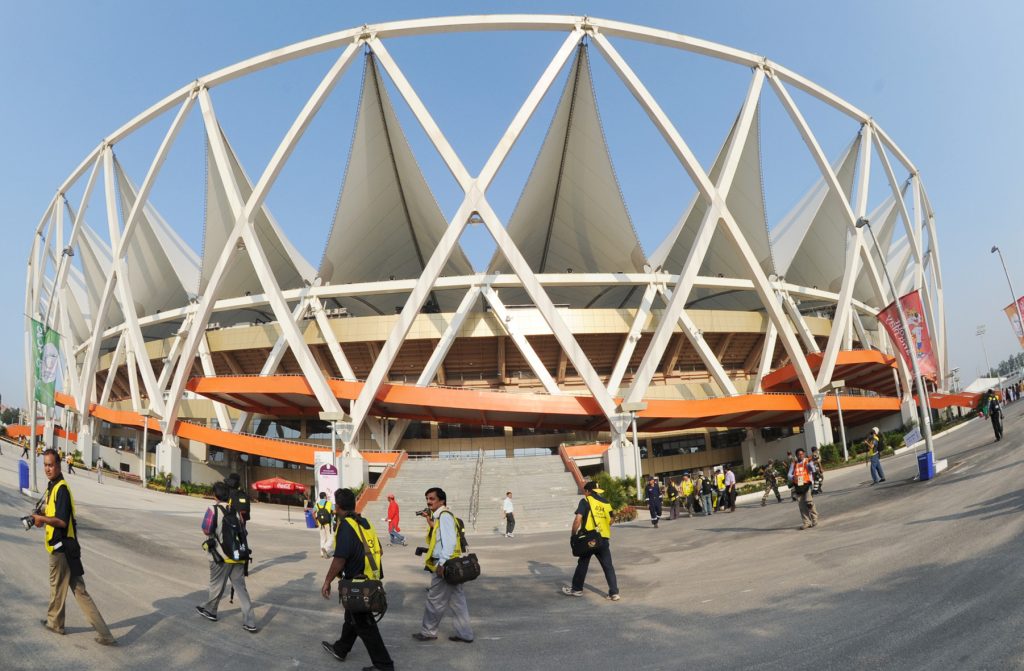
Commonwealth Games security in Delhi in 2010 worked, and the fact that nothing happened is itself worth examining. Having to abandon all thought of a successful strike because of the security arrangements can be as frustrating for a terrorist as a successful attack is for the security forces. That no strike took place during the Games can be read as a success of deterrence.
The difficulty is that the arrangement was event-specific. Once it was dismantled, other crowded parts of the city remained open to a chemical, biological, radiological or nuclear incident. This article by Dr Rakesh Kumar Sharma, then Scientist ‘G’ and Head of the Division of CBRN Defence at the Institute of Nuclear Medicine and Allied Sciences, appeared in Defence and Security Alert in July 2011.
Why Commonwealth Games security mattered
Terrorist targets in India have tended to be densely populated places: markets, centres of religious faith, religious congregations, mass transport systems, shopping streets, economic centres, tourist destinations, hotels, critical infrastructure, hospitals, political meetings and major sporting events.
Large sporting events concentrate all of this. During the Commonwealth Games and the ICC Cricket World Cup, spectators gathered in their tens and hundreds of thousands across competition and practice venues, alongside athletes, officials and visiting dignitaries, with the world’s media present to carry news instantly. Groups seeking publicity want a large audience as much as they want casualties.
What the record actually shows
The article notes only four significant attacks using toxic materials as unconventional weapons over four decades. In September 1984, a cult in Oregon in the United States contaminated salad bars at ten local restaurants with Salmonella enterica Typhimurium in an attempt to depress turnout in a local election, making at least 751 people ill. In June 1990, LTTE rebels attacked a Sri Lankan Armed Forces base in Batticaloa district with chlorine gas canisters, injuring more than 60 personnel. In March 1995, members of a Japanese sect released sarin on five Tokyo subway lines, exposing nearly 5,000 people, killing 12 and sending close to 500 to hospital. In 2001, letters containing anthrax spores were mailed to news media offices and two United States senators, killing five people and infecting 17 others.
The technical capacity of groups to produce, acquire and deliver such weapons varies considerably, and achieving a catastrophic outcome requires a scale of operation that very few have managed. In most cases conventional explosives remain the greater danger.
What DRDO contributed
The Ministry of Defence and DRDO prepared national and local response forces to protect against, deter and respond to incidents involving hazardous CBRN materials. Training was designed for government emergency responders from military, paramilitary and civilian services, and aimed at building awareness along with the techniques, procedures, knowledge and skills needed for such situations.
The courses gave trainees an overview of international and domestic threats, with a focus on detecting an incident and on identifying and decontaminating hazards. They also covered personal protective equipment for working in an all-hazards environment, and the preservation of scene evidence for forensic investigation. The five-day programme moved from classroom teaching to hands-on experience and interactive sessions with experts, with mock exercises in which trainees located and identified a toxic substance and practised coordination.
What should follow Commonwealth Games security
The skilled manpower, logistics and infrastructure available for managing an incident of this kind was, at the time, far from adequate. The trained personnel created for the Games should therefore be retained, and the network of trained people widened until all densely populated areas of the city are covered. The same should then be repeated in every major city in India, with good practice and lessons shared across comparable events.
CDPRR continues this work through its CBRN training modules and capacity-building workshops, and has written separately on CBRN disaster prevention and radiological terrorism.
(Read the full article in PDF format)