
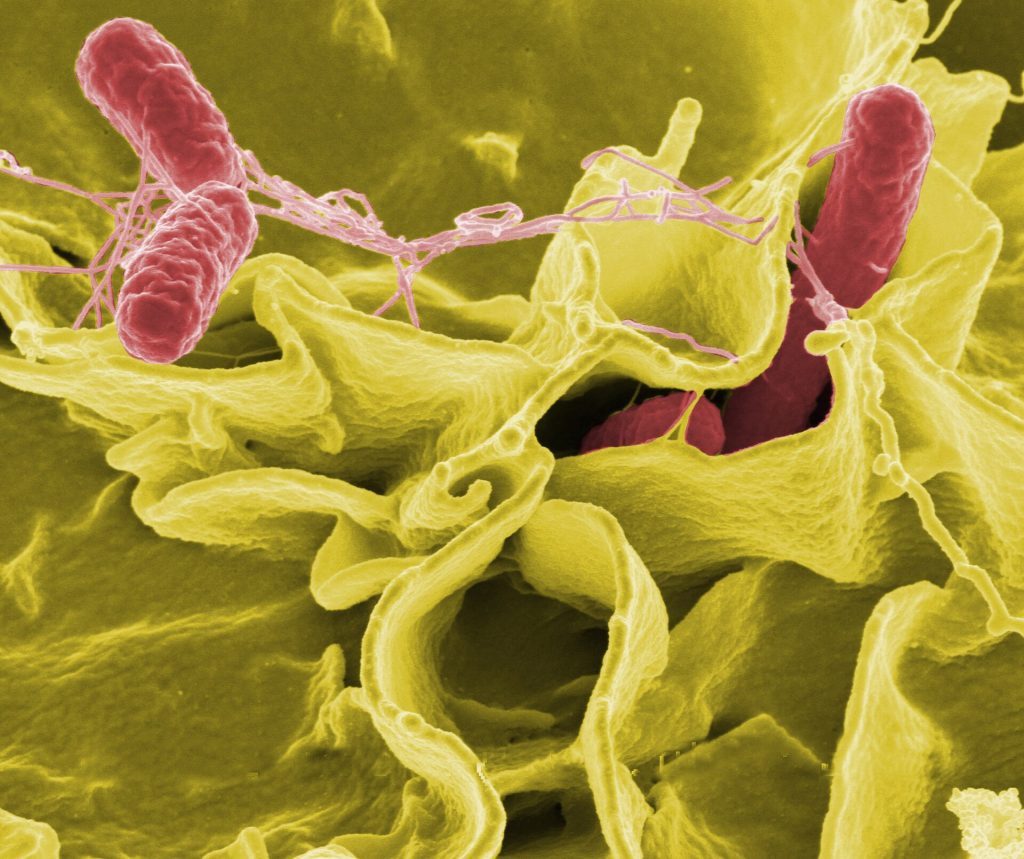
Antibiotic-resistant Salmonella is now one of the harder problems in infectious disease, because the treatment options are shrinking while the organism spreads more widely. This study used a bio-matrix based selection method to identify plant products that might work against it, and then predicted their bioactivity computationally.
It was published in Biochemistry & Analytical Biochemistry in 2015 by Ankit Tanwar, Pallavi Thakur, Raman Chawla, Sarita Jaiswal, Ankita Singh Chakotiya, Rajeev Goel, Rakesh Kumar Sharma, Haider Ali Khan and Rajesh Arora.
Why antibiotic-resistant Salmonella is a growing problem
Re-emerging strains of commensal micro-organisms such as Salmonella enterica are affecting human populations because of their greater penetrance in the ecosystem and the limited treatment now available. Outbreaks of multi-drug resistant Salmonella enterica serovar Typhimurium in the Indian subcontinent, Southeast Asia and Africa have accounted for roughly 16 million cases a year. Infections that were once contained within hospitals now penetrate at community level.
The resistance profile has also shifted from multi-drug resistance towards extensive drug resistance, with resistance recorded against tetracycline, streptomycin, sulfamethoxazole, ampicillin and ceftriaxone. The emergence of strains resistant to ciprofloxacin widened the risk further. Resistance in these pathogens is attributed to chromosomal mutations and to the selective pressure of the synthetic drugs used in treatment.
Salmonella is also associated with reactive arthritis, which has a reported global expressivity of between 6 and 30 per cent. Its incubation period is unclear, spanning two to four weeks after the enteric infection begins. Reactive arthritis is reported alongside other food-borne illnesses too, including Campylobacter and Shigella. Infections of this kind place a long and expensive burden on healthcare systems.
The case for natural plant products
Natural plant products with medicinal potential, drawn from either traditional or modern medicine, serve as a source of roughly 5,000 compounds per species. Plants produce these secondary metabolites to defend themselves against bacteria, fungi and viruses, and they can be used in much the same way in medicine.
They are attractive because of their broad-spectrum activity, limited or no side effects, better acceptability and local availability. Even so, the Indian subcontinent holds only 2 per cent of the global herbal medicine market despite having 7,000 Ayurvedic, 700 Unani and 600 Siddha medicines alongside 30 modern ones, which points to a lack of directed research.
How the candidates against antibiotic-resistant Salmonella were selected
The study used an in silico ‘Herbal Informatics’ model with dynamic search protocols, priority indexing and systematic categorisation, aimed at the critical virulence factors of the resistant strain. Biochemical activity was then predicted using a cheminformatics tool to assess drug-likeness.
Of five selected bioactivity parameters, lipopolysaccharide inhibition was the most relevant physiological target at 65 per cent, followed by enterochelin inhibition, Type III secretory system inhibition, superoxide dismutase inhibition and symptomatic relief.
A binary matrix analysis of 50 plants identified through classical bioprospection filtered 28 that could potentially act on three or more virulence factors. Weightage matrix analysis narrowed this to 10 scoring above the median of 14.98, and fuzzy score matrix analysis confirmed the final 10: Abrus precatorius, Azadirachta indica, Camellia sinensis, Holarrhena antidysenterica, Andrographis paniculata, Adhatoda vasica, Euphorbia hirta, Ocimum sanctum, Terminalia arjuna and Terminalia belerica.
What the predictions showed
Bioactivity prediction of the main constituents pointed to four with drug-likeness: conessine from Holarrhena antidysenterica, andrographolide from Andrographis paniculata, amyrin from Euphorbia hirta and arjunolic acid from Terminalia arjuna. Each was predicted to act as a GPCR ligand, a nuclear receptor ligand or a protease inhibitor.
Related work on this site includes the in silico identification of natural radioprotectors and an E. coli biosensor for water samples. The World Health Organization publishes a fact sheet on non-typhoidal Salmonella.
The full paper is available at doi.org/10.4172/2161-1009.1000217.
(Read the full paper in PDF format)
Pingback: Natural Radioprotectors: In Silico Identification of Leads