
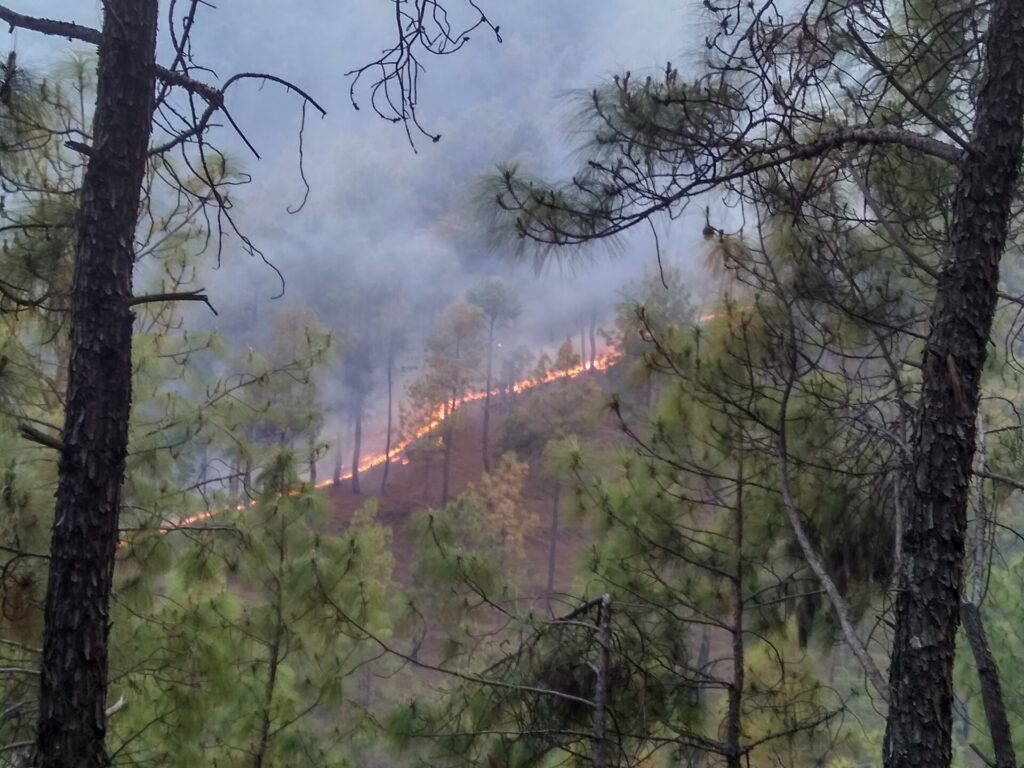
On the afternoon of 13 June 2024, eight forest workers were sent to put out a fire in the Binsar Wildlife Sanctuary in Almora district. As they stepped down from their vehicle, a strong wind pushed the fire towards them. Four died on the spot: a beat officer, a fire watcher, a Provincial Armed Constabulary jawan and a daily-wage worker. By the end of that season, forest fires had killed 12 people in Uttarakhand, six of them forest department staff.
The fire season had been running for months by then. Satellites picked up 21,033 forest fire counts in Uttarakhand between November 2023 and June 2024, against 5,351 the season before. The state went from 13th to first in the country.
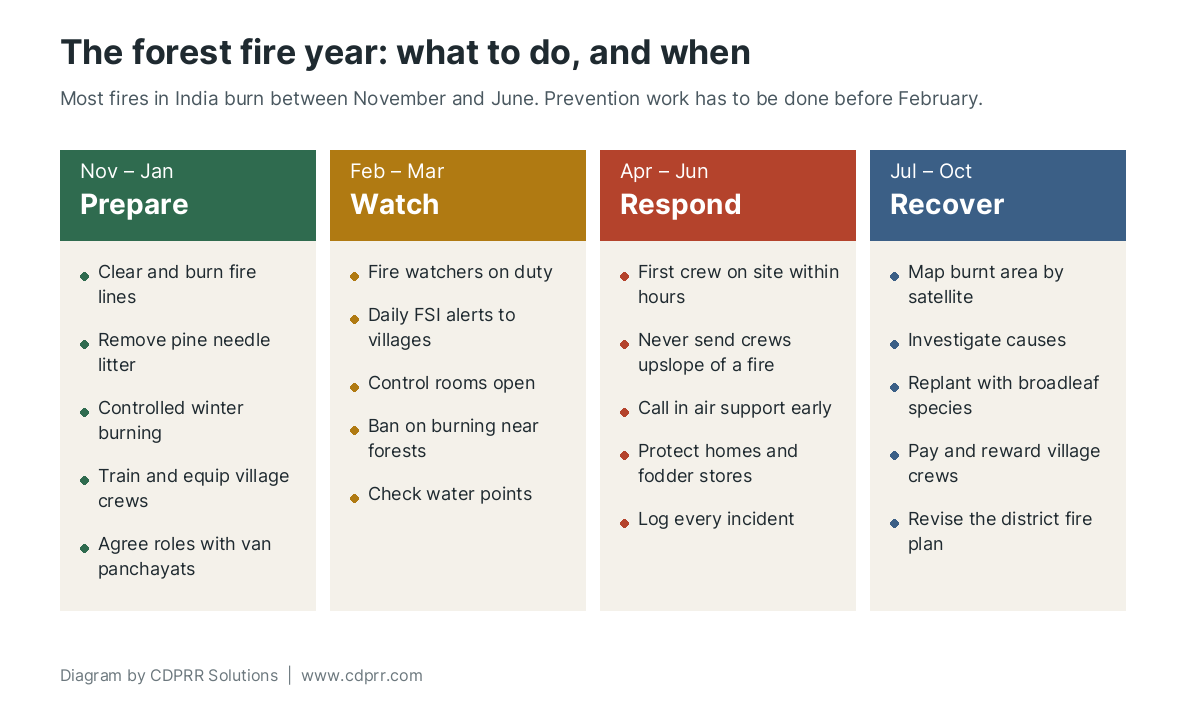
Fires like Binsar are fought in summer, but they are lost or won between November and January, when fuel is cleared, fire lines are cut and village crews are organised.
How big the problem is
Most of India’s forest fires are surface fires that burn leaf litter, grass and undergrowth. The Forest Survey of India (FSI) detected 2,03,544 forest fires in the November 2023 to June 2024 season and 2,38,309 in the season that followed. About 34,562 sq km of forest burnt in 2023-24.
The India State of Forest Report 2023 classes 27.97 per cent of the country’s forest cover as highly, very highly or extremely fire-prone, up from 22.27 per cent in the previous report. The North East, central India, Odisha and Andhra Pradesh carry the largest share. According to FSI analysis, more than 95 per cent of these fires are started by people: burning to bring up fresh grass for cattle, clearing farm stubble, collecting forest produce, a discarded cigarette.
The season is also starting earlier. A Down To Earth analysis of NASA satellite data found that fire activity in India’s forests in the first two months of 2026 was more than 80 per cent above the average since 2014. In May, the Indian Air Force was helping fight fires around Kasauli in Himachal Pradesh.
Prepare before the fire season
Most of the work that stops a fire from spreading is done in winter, when the ground is still damp enough to work safely.
Fire lines
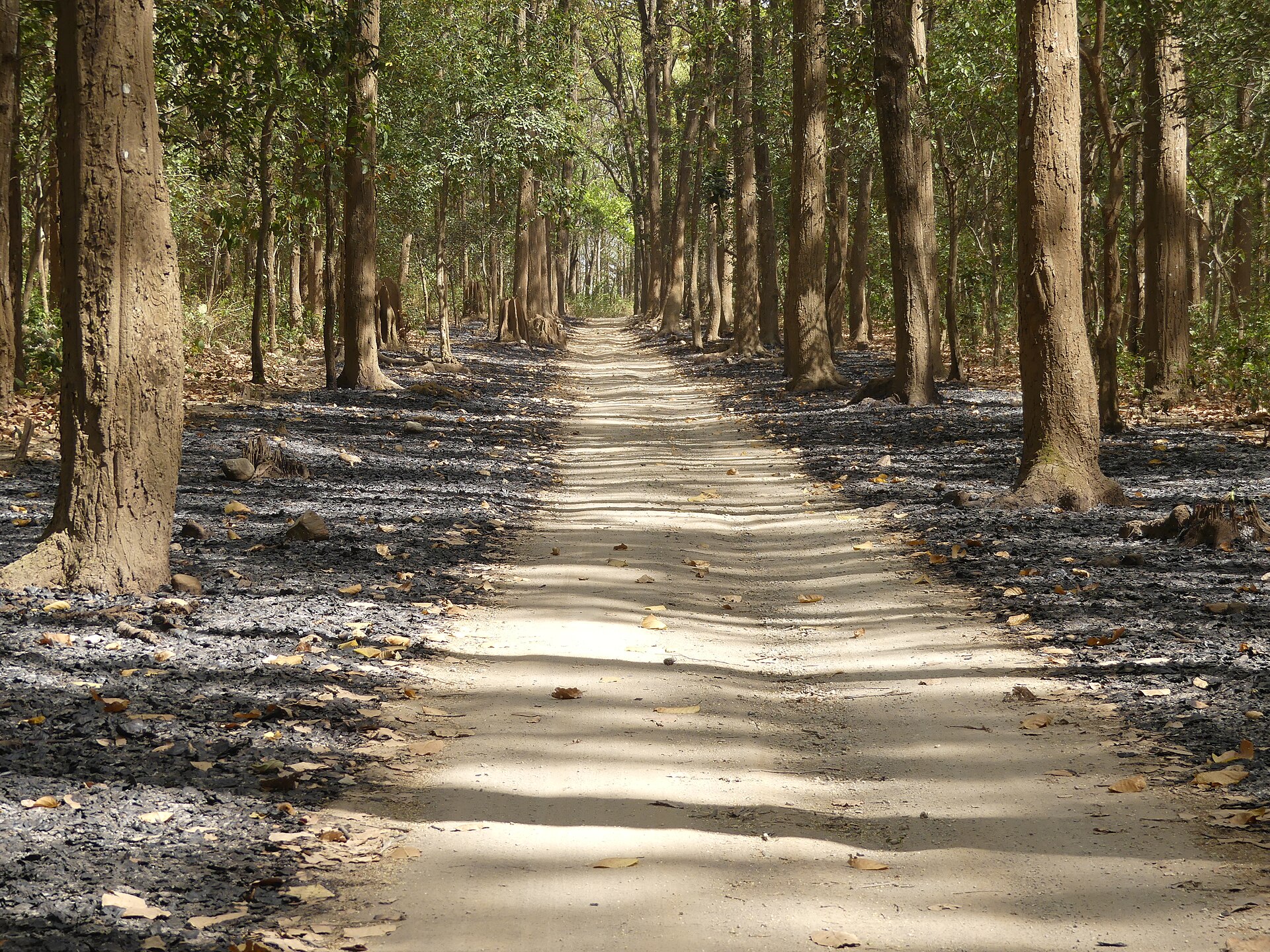
Fire lines are strips cleared of trees and undergrowth, ranging from a few metres to more than a hundred metres wide, which break up the forest into blocks so a surface fire runs out of fuel. They only work if they are cleared and controlled-burnt every winter. A line left full of dry leaves helps a fire across instead of stopping it. Forest officers in Uttarakhand have repeatedly said that delays in releasing funds in November and December mean fewer fire lines are cleared before February.
Fuel load
Chir pine covers about 16 per cent of Uttarakhand’s forest area, mostly between 1,000 and 1,800 metres. Its resin-rich needles, known locally as pirul, pile up on the forest floor and burn fast. The state produces an estimated 1.8 million tonnes of pirul a year. In May 2024, under the Pirul Lao-Paise Pao scheme, the state raised the price it pays for pirul at collection centres to Rs 50 a kg, up from a few rupees earlier. It turns fuel removal into income, but only works with collection centres close to villages and buyers for the pirul.
Controlled burning
Many hill communities burn grassy slopes in December and January, when fires are low and slow, to bring up fresh grass and reduce summer fuel. Under forest law only state agencies may carry out such burns, so village burning is often done quietly, and secret burning is more likely to get out of control. Bringing traditional burning into the district fire plan, with agreed dates, places and supervision, is safer than pretending it does not happen.
Put communities in charge of their forests
The National Action Plan on Forest Fires, issued by the Ministry of Environment, Forest and Climate Change in 2018, sets out its main aim as reducing forest fires by informing, enabling and empowering forest fringe communities, and giving them incentives to work with state forest departments. The reason is practical. People who live next to a forest usually see the smoke before a satellite does.
Uttarakhand has more than 11,000 van panchayats, village forest councils that date back to rules framed in 1931, which manage over 7 lakh hectares. Where they work well, members clear fire lines and turn out to fight fires because the forest supplies their fodder, fuelwood and leaf litter. But sarpanches say money for fire protection reaches them late and unevenly. In financial year 2023 the state allocated Rs 6.3 crore under its fire protection scheme to van panchayats and Rs 15.8 crore to reserved forests.
After the 2024 season, Uttarakhand began to lean on villages more directly. It set up WhatsApp groups that bring together village heads, van panchayat leaders, Mahila Mangal Dal members and forest staff, so that fire alerts reach people within minutes, and formed forest fire safety committees at gram panchayat level. It gave fire kits, with rakes, torches, water bottles and protective jackets, to 45 forest panchayats in high-risk areas and promised Rs 30,000 to each of 50 panchayats that protected their forests through the season.
Odisha offers a similar lesson. In early 2021 a fire in the Similipal Tiger Reserve burned for more than ten days and affected close to a third of its area. Analysis of FSI fire data by local researchers suggested that forests where villages held community forest rights under the Forest Rights Act were among the least damaged. The following year the forest department engaged 320 fire watchers and identified 130 vulnerable villages for awareness work.
Detect early, respond fast
India’s detection system is good. FSI sends three kinds of alerts to forest officials and registered users: pre-fire alerts a week in advance, near real-time alerts based on satellite fire detections, and alerts for large fires. The weak link is the last mile, from the alert to a crew on the ground.
A fire caught in its first hours can be put out with rakes, beaters and blowers. In the 2023-24 season, the environment ministry reported that 67 per cent of major fires were put out within 24 hours. The rest are the fires that kill people and burn for weeks. Districts can shorten the gap with:
- alerts sent straight to village crews as well as forest offices;
- fire watchers on duty from February, from villages close to the forest;
- fire control rooms with clear authority to call in fire services, the State Disaster Response Force and, for large fires, the trained NDRF teams and air support;
- basic safety rules for every crew: work from the burnt side or from below, keep an escape route, and never go upslope of a fire in strong wind.
Firefighters also need to be paid on time and insured. Reports after the Binsar deaths found that many fire guards in the area had not been paid since 2022.
Recover and learn after the season
When the rains arrive, the burnt area should be mapped from satellite data, causes investigated and the district fire plan revised. In the Kumaon hills, mixed forests that burn often grow back with pine as the dominant tree, which makes the next fire more likely. Replanting with oak, rhododendron and other broadleaf species where they suit the site, and paying the village crews and panchayats that kept fires down, both feed into the following season.
Key takeaways for practitioners
- Treat the fire season as a year-round cycle; most prevention work has to be finished by February.
- Clear and burn fire lines every winter, and release funds in time for it.
- Pay for fuel removal, such as pirul collection, close to the villages that do it.
- Bring traditional winter burning into the fire plan under agreed rules.
- Give van panchayats, forest rights holders and village crews money, equipment and authority, not only instructions.
- Send FSI alerts straight to village crews and act within hours.
- Train, equip, pay and insure every person sent to fight a fire.
- Map burnt areas, investigate causes and restore broadleaf forest after each season.
Next in the series: Industrial Safety Nets, on managing chemical spills and hazardous material accidents. To discuss forest fire risk mapping, community fire management or district fire plans, contact CDPRR Solutions at www.cdprr.com.